
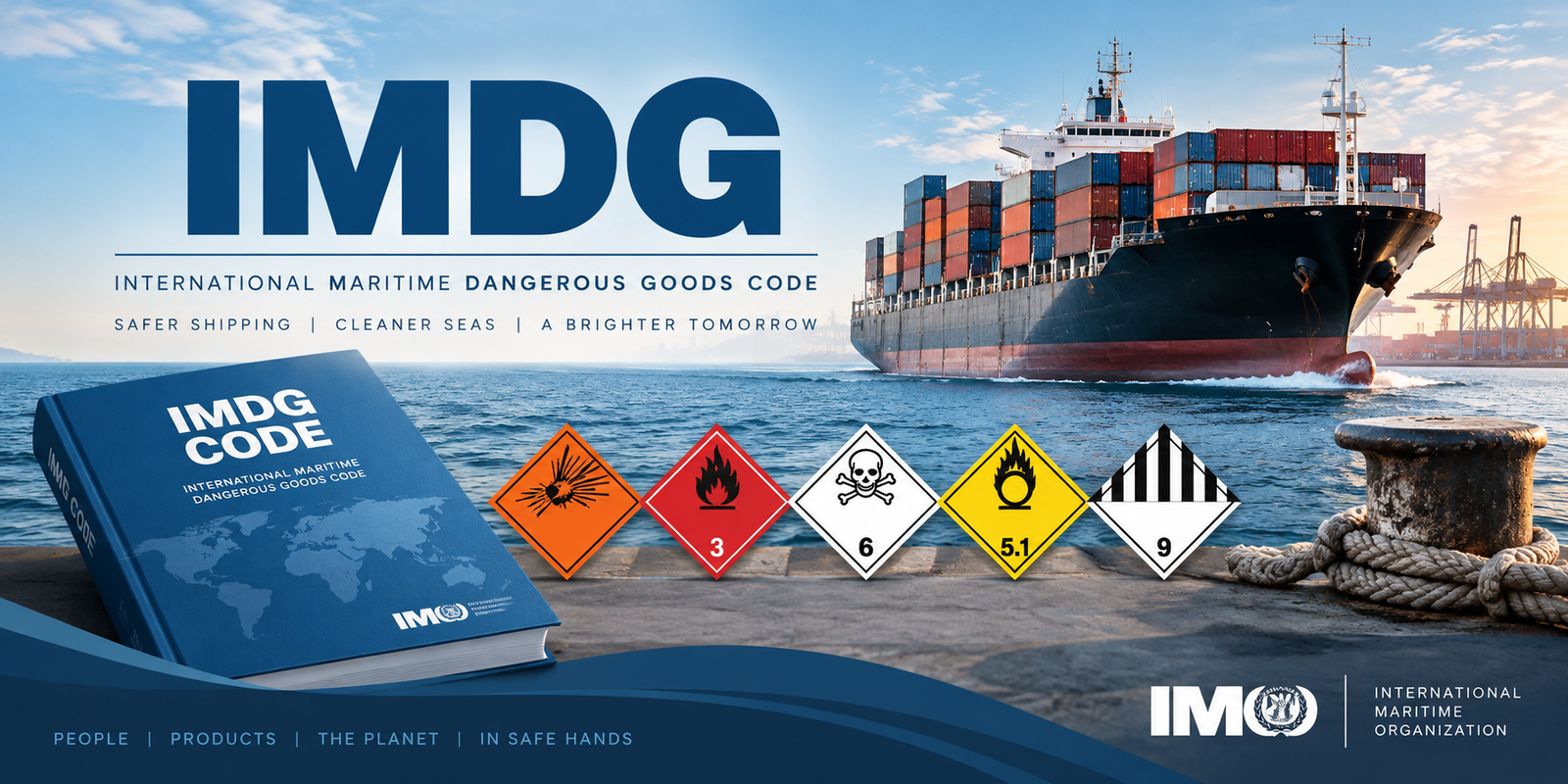
Companies in the United States that ship dangerous goods by sea operate within an international transportation system. A container may be packed at a warehouse in Ohio, transported by truck to a port in New Jersey, loaded onto an ocean vessel and eventually delivered to a customer in Europe, Asia or South America. Throughout that journey, different regulatory systems can apply. For the maritime part of the transport chain, one of the most important is the International Maritime Dangerous Goods Code, better known as the IMDG Code.
For U.S. companies, however, compliance with the IMDG Code should not be viewed separately from the U.S. Hazardous Materials Regulations. Employees involved in preparing hazardous materials for ocean transport may have training obligations under both the IMDG Code and Title 49 of the Code of Federal Regulations. Understanding how these requirements interact is therefore essential for shippers, freight forwarders, warehouses, consolidators, container packing facilities and other organizations involved in international maritime transportation.
Why IMDG training is required
The IMDG Code establishes internationally recognized requirements for transporting dangerous goods by sea. Its provisions address subjects including classification, packaging, marking and labeling, documentation, container packing, segregation, stowage and emergency response.
Chapter 1.3 of the IMDG Code specifically addresses the training of shore-based personnel. The principle is straightforward: personnel involved in transporting dangerous goods intended for carriage by sea must receive training appropriate to their responsibilities.
This obligation covers considerably more than employees physically loading containers. The IMDG Code identifies numerous activities that can bring personnel within its training framework. These include classifying dangerous goods, selecting proper shipping names, packing dangerous goods, marking and labeling packages, placarding cargo transport units, preparing dangerous goods documentation, offering dangerous goods for transport and loading or unloading cargo transport units.
Personnel involved in preparing loading or stowage plans, accepting dangerous goods for transport, handling dangerous goods during transport and carrying out compliance inspections can also require appropriate training.
The important principle is that training should correspond with the employee’s actual responsibilities. An employee preparing dangerous goods documentation requires different detailed knowledge from someone whose task is to mark packages or load a freight container.
The connection with U.S. 49 CFR requirements
For American companies, the IMDG Code is only part of the regulatory picture. The U.S. Department of Transportation’s Pipeline and Hazardous Materials Safety Administration, or PHMSA, regulates hazardous materials transportation under the Hazardous Materials Regulations.
The federal hazmat training requirements are primarily contained in 49 CFR Part 172, Subpart H, including §§172.700 through 172.704. PHMSA states that hazmat employers must train, test and certify their hazmat employees and maintain the required training records.
The definition of a hazmat employee is deliberately broad. It is based primarily on the functions an individual performs rather than their job title. Employees who load, unload or handle hazardous materials, prepare hazardous materials for transportation, inspect packaging or perform other functions that directly affect hazardous materials transportation safety can fall within the definition.
Consequently, an employee working for an American company may be subject to U.S. hazmat training requirements even when the shipment is ultimately being prepared in accordance with the IMDG Code.
This is particularly relevant because 49 CFR permits the use of certain international standards for international shipments. When the IMDG Code is used under the authorization provided by the HMR, the employee must understand the international requirements applicable to the function being performed.
PHMSA has specifically addressed this relationship. The agency has explained that training conducted to comply with the IMDG Code may be used to satisfy applicable 49 CFR training requirements to the extent that the training covers the components required by §172.704. If the IMDG training does not cover all applicable HMR requirements, additional training must be provided.
In practical terms, an IMDG certificate by itself should therefore not automatically be interpreted as proof that every U.S. DOT training requirement has been satisfied.
What training must U.S. hazmat employees receive?
Under 49 CFR §172.704, required hazmat employee training includes several elements. Employees must receive general awareness and familiarization training so they can recognize hazardous materials and understand the general structure of the regulations. They must also receive function-specific training covering the regulatory requirements applicable to the tasks they actually perform.
Safety training is another component and addresses subjects such as emergency response information, measures to protect employees from hazards and methods for preventing accidents. Security awareness training is required as part of the federal training framework, while employees working under a required hazardous materials security plan may also need in-depth security training. Depending on the employee’s responsibilities and transportation mode, additional modal or specialized training requirements can apply.
For an employee preparing an ocean shipment, function-specific training may therefore need to include IMDG requirements concerning matters such as classification, packaging, marks and labels, marine pollutants, dangerous goods documentation, segregation and container placarding.
This function-based approach is particularly important for companies purchasing online training. A general IMDG awareness course can provide an excellent foundation, but general awareness should not automatically be confused with complete function-specific qualification for every dangerous goods activity.
A person responsible only for recognizing dangerous goods may need a different level of training from a dangerous goods specialist responsible for classifying chemicals, selecting packaging and signing shipping documentation.
Training before performing dangerous goods functions
The IMDG Code states that shore-based employees should be trained in accordance with Chapter 1.3 before assuming responsibilities. Where required training has not yet been provided, functions should only be performed under the direct supervision of a trained person. The Code also calls for refresher training to account for regulatory and practical changes.
The U.S. HMR contains a related but distinct rule. PHMSA allows a new hazmat employee, or an employee who changes job functions, to perform regulated functions before completing training for up to 90 days, but only when working under the direct supervision of a properly trained and knowledgeable hazmat employee. Required training must be completed within that period.
Companies should therefore be careful not to assume that the U.S. 90-day provision eliminates the need to consider the requirements of an international code being used for a particular shipment.
Refresher training and regulatory changes
There is another important difference that deserves attention. Under 49 CFR, recurrent hazmat employee training is generally required at least once every three years. PHMSA also requires employers to maintain current training records, including information concerning the employee, completion date, training materials, trainer and certification of training and testing.
The IMDG Code requires training to be periodically supplemented with refresher training so personnel remain familiar with changes in regulations and practice. Because the IMDG Code is regularly amended, companies involved in maritime dangerous goods transportation should not simply wait for a calendar-based retraining date when a regulatory change directly affects an employee’s work.
PHMSA has addressed exactly this situation. When an amendment to the IMDG Code changes requirements relevant to a hazmat employee’s function, the employer does not necessarily have to repeat the entire training program immediately. However, the employee must receive the instruction necessary to understand the new or revised requirement. The normal three-year U.S. recurrent training cycle remains applicable.
This makes regulatory update training an important part of a robust dangerous goods training program.
Training records are part of compliance
Training is not complete simply because an employee attended a course. Under the U.S. system, the employer carries significant responsibility for demonstrating compliance.
PHMSA requires hazmat employers to train and test employees, certify that the required training has been completed and maintain records of current training. These records must be retained during employment and for 90 days thereafter, covering the current training cycle and the preceding three years as applicable.
Employers should therefore maintain a structured training matrix identifying which employees perform regulated dangerous goods functions, which modes of transport are involved and which training modules apply to each role.
For businesses shipping dangerous goods internationally, this matrix might combine general U.S. DOT hazmat training with specific modules covering highway, vessel, IMDG, air or other applicable requirements.
IMDG training as part of a U.S. compliance program
For American exporters and logistics companies, the most effective approach is to stop thinking about IMDG and 49 CFR as two completely separate training systems. They overlap, but they are not identical.
A warehouse employee packing dangerous goods into an ocean container may need knowledge of the IMDG Code while simultaneously performing functions regulated under the U.S. HMR. A shipping specialist preparing documentation may need detailed knowledge of both systems. A freight forwarder accepting dangerous goods from customers must understand which requirements apply before cargo reaches the vessel.
The employer should begin by identifying the functions each employee performs. From there, the required general awareness, function-specific, safety, security and modal training can be determined.
This approach does more than satisfy a regulatory requirement. Proper training reduces the likelihood of incorrect classification, incompatible cargo being loaded together, missing marks and labels, rejected containers, incorrect documentation and dangerous incidents during transportation.
For U.S. companies participating in international maritime trade, IMDG knowledge is therefore not simply an additional qualification. When employees prepare, offer, handle or document dangerous goods for ocean transportation, appropriate IMDG training can form an essential part of the company’s wider U.S. hazardous materials compliance program.