
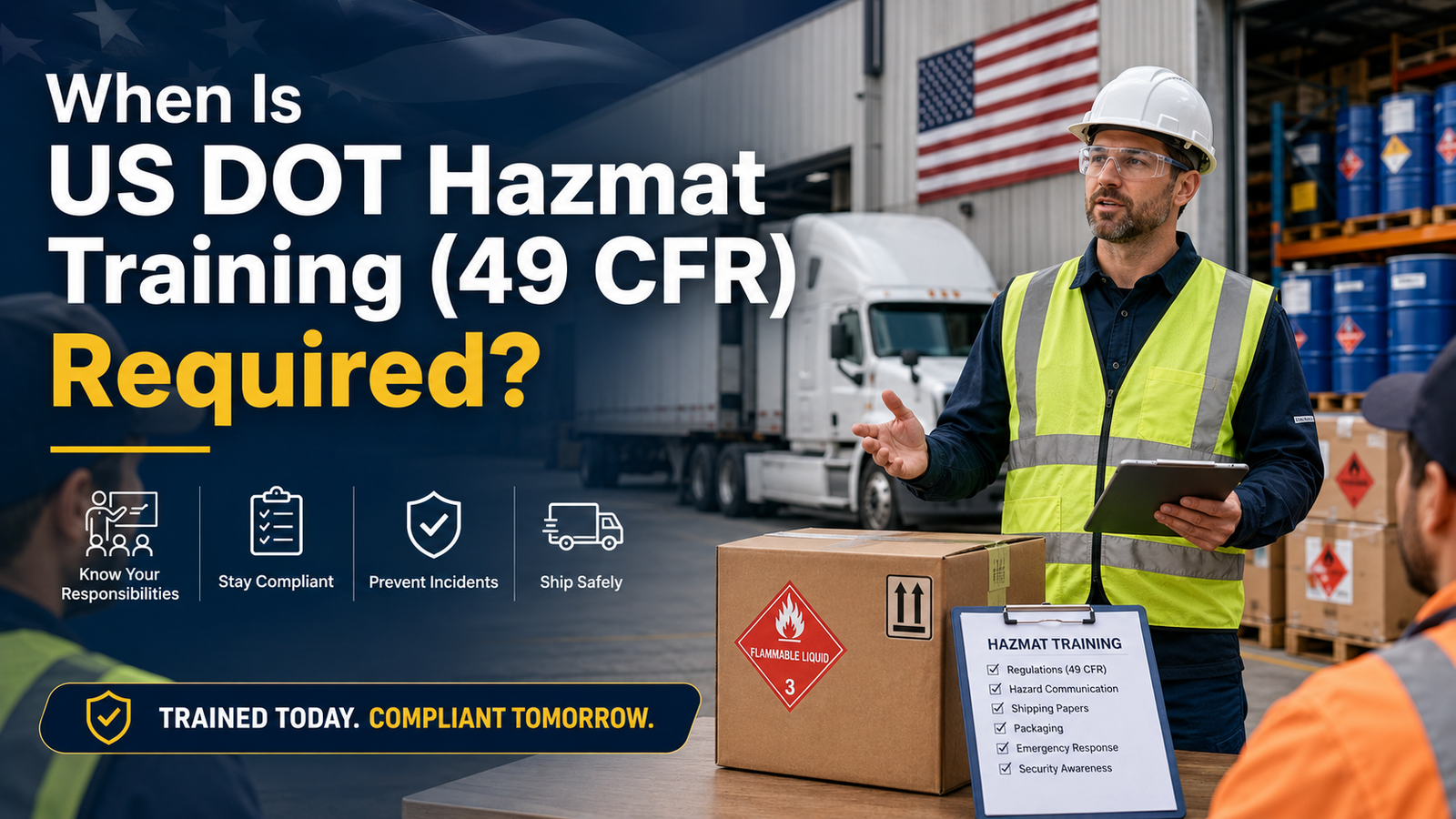
Organizations that ship, prepare, handle, or transport hazardous materials in the United States have an important duty: employees whose work directly affects hazardous materials transportation safety must be properly trained. The principal requirements appear in the U.S. Department of Transportation’s Hazardous Materials Regulations (HMR), particularly 49 CFR Part 172, Subpart H.
The obligation is broader than many businesses realize. It does not apply only to truck drivers or employees working for chemical companies. Warehouse personnel, shipping clerks, supervisors, and packaging technicians may also be “hazmat employees.”
Who is considered a hazmat employee?
Under 49 CFR, the decisive factor is the function a person performs—not their job title. A hazmat employee is generally someone whose work directly affects the safe transportation of hazardous materials. This may include employees who:
- classify a material or select its Proper Shipping Name;
- choose, fill, close, inspect, or prepare packaging;
- mark or label packages;
- prepare, sign, enter, or verify shipping-paper information;
- determine whether placards are required;
- load, unload, or handle hazardous materials in transportation;
- operate a vehicle used to transport hazardous materials;
- manufacture, inspect, repair, or test regulated packaging; or
- supervise employees performing regulated hazmat functions.
The definition can cover permanent and temporary workers, part-time personnel, self-employed persons, and certain contractors. A person does not escape the requirement merely because hazardous materials are only a small part of their work.
Conversely, being present at a facility where hazardous materials are stored does not automatically make someone a hazmat employee. The question is whether that person performs a function regulated by the HMR and directly affects transportation safety. Applicability should always be checked against the actual operation.
What training is required?
49 CFR § 172.704 establishes several mandatory training components.
General awareness and familiarization training introduces the HMR and enables employees to recognize and identify hazardous materials. Function-specific training addresses the precise regulatory requirements that apply to the employee’s duties. A shipping clerk, packer, forklift operator, and driver therefore do not necessarily need identical training.
Safety training must cover emergency-response information, protection from hazards to which the employee may be exposed, and methods for preventing accidents.
Security-awareness training addresses transportation-security risks and how to recognize and respond to possible threats. Employees involved with hazardous materials covered by a required security plan must also receive in-depth training on that plan, including their specific responsibilities and the actions required during a security breach.
Additional modal training may be necessary. For example, a hazmat employee who drives a motor vehicle must receive the applicable driver training. Air, vessel, and rail transportation may also bring mode-specific requirements. The employer must ensure that training covers the employee’s real tasks, materials, transport modes, and company procedures.
When must initial training be completed?
A new hazmat employee must complete the required training within 90 days after employment. The same 90-day period applies when an existing employee changes job functions and begins performing new regulated duties.
This does not create an unrestricted 90-day grace period. Before completing the required training, the employee may perform the relevant hazmat function only under the direct supervision of a properly trained and knowledgeable hazmat employee. If suitable direct supervision is unavailable, the untrained employee should not independently perform that function.
Training before the employee starts unsupervised work is the safer approach. The employer remains responsible for compliance even while the employee is still within the initial training period.
How often must hazmat training be repeated?
Recurrent training is required at least once every three years. PHMSA states that the three-year period begins on the actual date the employee completes the training. Employers should therefore monitor individual completion dates rather than assigning one approximate renewal year to the entire workforce.
The three-year interval is a maximum, not a guarantee that no earlier instruction will be needed. Earlier or additional training may be required when:
- the employee changes functions or assumes new hazmat responsibilities;
- new or amended HMR provisions affect the functions performed;
- the company begins handling different hazards, packaging types, or transport modes;
- a special permit, exception, or company procedure changes; or
- a required security plan is revised.
PHMSA explains that employees must be instructed on applicable new or revised function-specific requirements according to the compliance timeline of the regulatory change, without waiting for the next three-year cycle.
When an in-depth security plan is revised during the cycle, affected employees must be trained on the revision within 90 days after its implementation.
Can previous training be accepted?
Relevant training received from a previous employer or another source may be credited if the new employer obtains a current training record. However, the new employer must assess whether that training actually covers the employee’s assigned functions. Any missing elements must be added.
Training completed under OSHA, EPA, the ICAO Technical Instructions, or the IMDG Code may satisfy portions of the HMR requirement to the extent that the same components are covered. It does not automatically replace U.S. DOT training.
For example, an employee with IMDG Code training may already understand hazard classes, UN numbers, packaging, marking, labeling, and shipping documentation. Nevertheless, the employer must verify whether that training adequately addresses the relevant U.S. requirements, security awareness, applicable domestic provisions, and the specific functions performed by the employee.
Is online hazmat training permitted?
Online and computer-based training are permitted. According to PHMSA’s hazardous materials training guidance, training may be classroom-based, online, virtual, self-directed, or delivered by an external provider, provided all applicable subjects are covered and the employee is tested.
PHMSA does not prescribe one universal examination format. Testing may be written, oral, electronic, or practical, as long as it demonstrates that the employee can competently perform the assigned hazmat functions. Merely passing a test without completing the required training does not satisfy the recurrent-training obligation.
For organizations seeking a practical online starting point, the SafetyNet USA US DOT Hazmat Training (49 CFR) provides flexible e-learning on core HMR topics, including classification, packaging, hazard communication, shipping papers, safe handling, security, and incident response.
A general online course can provide a broad compliance foundation. The employer must still determine whether additional function-specific, mode-specific, material-specific, or company-specific instruction is necessary.
What records must the employer retain?
The hazmat employer—not merely the training provider—is ultimately responsible for training, testing, certification, and recordkeeping. For every hazmat employee, the training record must include:
- the employee’s name;
- the completion date of the most recent training;
- a description, copy, or location of the training materials;
- the trainer’s name and address; and
- certification that the employee was trained and tested as required.
Current training records, including the preceding three years, must be retained for as long as the individual is employed as a hazmat employee and for 90 days afterward. Records must be made available to authorized enforcement officials upon request at a reasonable time and location.
A course certificate can form part of the record, but a certificate alone may not contain every item required by § 172.704(d). Employers should therefore retain the relevant course materials or their location, trainer details, completion information, test results, and the employer’s certification documentation.
The employer remains responsible
Purchasing a course or issuing a certificate does not transfer compliance responsibility. The employer must identify regulated functions, match training to them, verify competence, provide task-specific instruction where necessary, and maintain records.
A sound training program should therefore begin with an analysis of each employee’s duties. It should be reviewed whenever operations, materials, packaging methods, transport modes, security arrangements, or regulations change—not only when the three-year renewal date approaches.
Regulatory note: This article provides general information and is not legal advice. Employers should verify the current Hazardous Materials Regulations and any mode-specific, state, special-permit, or material-specific requirements applicable to their operations.
