
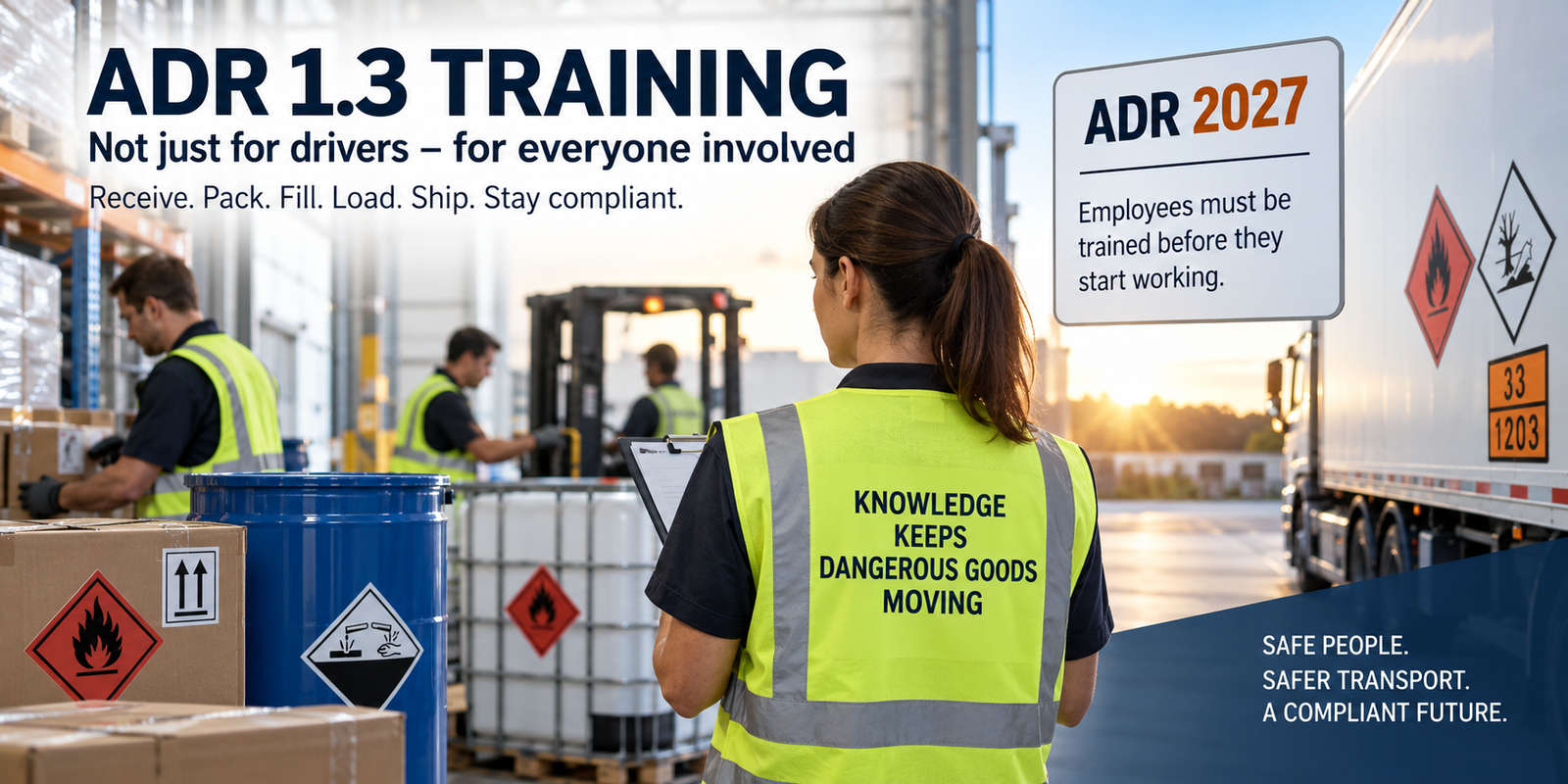
For American companies involved in international chemical trade, logistics, manufacturing or distribution, compliance does not stop at the U.S. border. A shipment prepared in Houston, Chicago or New Jersey may ultimately travel by road from Rotterdam to Germany, from Antwerp to France or from a European seaport to a distribution center somewhere else on the continent. Once dangerous goods enter the European road transport system, ADR becomes one of the most important regulatory frameworks to understand.
ADR is the international agreement governing the carriage of dangerous goods by road. It establishes detailed requirements for the classification, packaging, marking, labeling, documentation, loading, unloading and transportation of dangerous goods. It also establishes responsibilities for the different participants in the dangerous goods supply chain and requires personnel involved in these activities to receive appropriate training.
For U.S. businesses exporting chemicals, batteries, paints, aerosols, fuels and other hazardous materials to Europe, understanding ADR can therefore be an important part of international compliance.
What is ADR?
ADR stands for the Agreement concerning the International Carriage of Dangerous Goods by Road. It was originally adopted in Geneva in 1957 under the auspices of the United Nations Economic Commission for Europe and entered into force in 1968.
Although ADR is strongly associated with Europe, it should not simply be viewed as an EU regulation. ADR is an international agreement administered within the United Nations framework. Its official title was changed in 2021 by removing the word “European,” reflecting its wider international relevance.
ADR is updated on a two-year cycle. The current ADR 2025 requirements became applicable on January 1, 2025, while a new edition is scheduled for 2027. This regular revision process allows the regulations to respond to new technologies, substances, packaging methods and transport risks.
The structure will look familiar to U.S. hazmat professionals. Dangerous goods are assigned UN numbers, proper shipping names, hazard classes and, where applicable, packing groups. Packages may require UN specification packaging, hazard labels, markings and specific documentation.
ADR recognizes nine principal hazard classes, ranging from explosives and gases to flammable liquids, toxic substances, corrosives and miscellaneous dangerous substances and articles. These classes originate from the broader United Nations system for the transport of dangerous goods and therefore have significant similarities with the classification system encountered under the U.S. Hazardous Materials Regulations.
The details, however, are not identical.
ADR and U.S. DOT 49 CFR
In the United States, hazardous materials transportation is primarily regulated under the U.S. Department of Transportation Hazardous Materials Regulations contained in 49 CFR Parts 171–180. ADR performs a comparable role for international road transportation between its contracting countries.
Both systems are strongly influenced by the UN Recommendations on the Transport of Dangerous Goods. This explains why an American hazmat professional examining an ADR shipment will recognize many elements immediately. A shipment might use the same UN number, similar proper shipping name, hazard class and UN specification packaging.
That similarity can also create a dangerous assumption: compliance with 49 CFR does not automatically mean compliance with ADR.
There are differences in exemptions, documentation, markings, vehicle requirements, Limited Quantity provisions, responsibilities of participants and numerous technical requirements. ADR also contains concepts that have a particularly important place within European road transportation, including specific requirements for vehicle equipment, orange-colored plates, transport categories, tunnel restrictions and the appointment of dangerous goods safety advisers in situations where the relevant requirements apply.
For an American exporter, the practical question should therefore not be whether a shipment is “hazmat compliant,” but with which regulations it must comply during each part of its journey.
A shipment may encounter several regulatory systems between the manufacturing plant and its final customer. U.S. road transportation can involve 49 CFR, the ocean leg may involve the IMDG Code, and subsequent road transportation in an ADR country can bring the shipment within the ADR framework.
ADR responsibilities extend beyond the truck driver
One of the most important ADR principles is that dangerous goods compliance is not solely the responsibility of the driver.
ADR Chapter 1.4 allocates obligations to different participants in the transportation chain. Depending on the operation, these can include the consignor, carrier, consignee, loader, packer, filler, unloader and tank-container or portable-tank operator.
This is important for companies that associate ADR training only with professional truck drivers.
A warehouse employee loading dangerous goods onto a vehicle can influence compliance. So can an employee selecting packaging, applying labels, preparing transport information or checking a shipment before dispatch. An incorrect UN number, unsuitable package, missing label or improperly prepared shipment can create a regulatory problem long before the vehicle begins its journey.
This principle leads directly to one of the most important training provisions within ADR: Chapter 1.3.
ADR Awareness 1.3 training
ADR 1.3 requires persons whose duties concern the carriage of dangerous goods to receive training appropriate to their responsibilities and duties.
The requirement is deliberately function-oriented. It does not mean that every employee needs the same depth of knowledge or must undertake the extensive training applicable to an ADR vehicle driver. Instead, personnel need sufficient knowledge to understand the rules, risks and requirements relevant to the work they actually perform.
ADR 1.3 divides this into three important areas.
General awareness training provides personnel with familiarity with the general requirements governing the carriage of dangerous goods. Employees should understand what dangerous goods are, how the regulatory system works and why special controls apply.
Function-specific training goes further. Personnel must understand the regulatory provisions directly connected with their duties and responsibilities. Someone involved in packaging may therefore need different detailed knowledge from an employee checking incoming dangerous goods or preparing goods for loading.
Safety training addresses the hazards and dangers presented by dangerous goods. Employees should understand the risks associated with incidents, exposure and handling and should be familiar with appropriate safe-working and emergency-response procedures.
Security requirements must also be considered where applicable.
ADR furthermore requires training to be periodically supplemented with refresher training to take account of changes in the regulations.
Who should consider ADR Awareness training?
For U.S. companies with European operations or customers, the range of employees who may benefit from ADR Awareness 1.3 training can be considerably broader than expected.
Personnel working in shipping departments, warehouses, distribution centers and chemical facilities may perform activities connected with dangerous goods transportation. The same can apply to employees preparing shipments, selecting packaging, arranging transport, loading vehicles, receiving dangerous goods or checking transport documentation.
American companies operating European subsidiaries should therefore examine functions rather than job titles when determining training needs.
This is particularly relevant where a U.S. company uses standardized global logistics procedures. A procedure developed around U.S. DOT requirements may provide a strong compliance foundation, but European personnel still need to understand the ADR requirements applicable to their functions.
ADR 1.3 also specifically recognizes multimodal transportation. Where dangerous goods transportation forms part of a multimodal operation, personnel must be aware of requirements relating to the other modes of transport relevant to that operation.
That can be especially important for transatlantic shipments moving under the IMDG Code before continuing by road under ADR.
ADR knowledge is relevant even before goods reach Europe
An American company does not necessarily need to operate trucks in Europe for ADR knowledge to become commercially valuable.
Packaging and logistics decisions made in the United States can affect what happens when the goods arrive at their destination. An international shipment that cannot continue legally or efficiently after arrival can result in delays, repacking, relabeling, additional handling and unexpected costs.
Companies exporting dangerous goods should consequently view regulatory compliance as a chain rather than as a collection of isolated transportation legs.
The U.S. Hazardous Materials Regulations themselves recognize several international dangerous goods frameworks under specified conditions and limitations. However, the use of international standards does not remove applicable U.S. requirements. In particular, U.S. hazmat training requirements can remain applicable, including function-specific training in relevant international standards where required.
This makes combined regulatory knowledge particularly valuable for organizations working on both sides of the Atlantic.
Building international dangerous goods competence
Global chemical supply chains increasingly require employees to understand more than one regulatory framework. U.S. DOT 49 CFR remains fundamental for hazardous materials transportation within the United States, while the IMDG Code governs dangerous goods transported by sea and ADR plays a central role in road transportation across its contracting countries.
Employees do not necessarily need to become dangerous goods specialists to perform every operational function. They do, however, need to recognize dangerous goods, understand the responsibilities connected with their work and know when specialist assistance is required.
ADR Awareness 1.3 training provides an accessible foundation for employees whose activities are connected with European road transportation of dangerous goods.
For U.S. manufacturers, exporters, freight forwarders and logistics companies serving European markets, that knowledge can help bridge the gap between U.S. hazmat compliance and the requirements encountered after a shipment crosses the Atlantic.
Doing business internationally means understanding the rules beyond your own border. SafetyNet USA’s ADR Awareness 1.3 Training introduces employees to the essential principles of ADR and helps organizations prepare personnel involved in the international dangerous goods supply chain.
For companies working with both U.S. and European dangerous goods transportation, ADR Awareness can complement U.S. DOT Hazmat training and help create a more consistent international compliance culture.
