
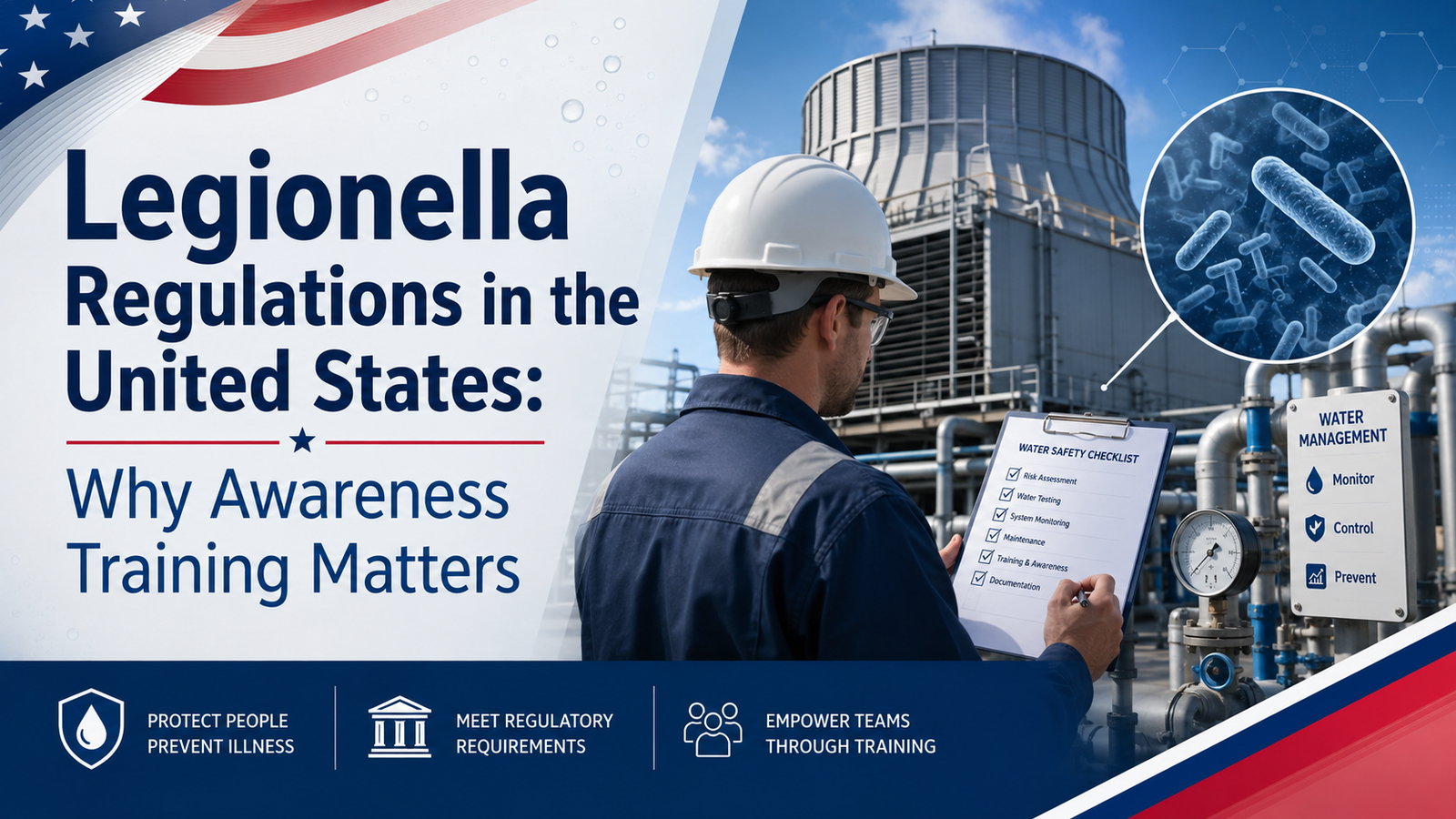
Legionella is a bacterium that can grow in human-made water systems and cause legionellosis. The most serious form, Legionnaires’ disease, is a potentially severe type of pneumonia. Pontiac fever is generally a milder, flu-like illness. Infection usually occurs when a person inhales small droplets of contaminated water. Potential sources include cooling towers, showers, faucets, hot tubs, decorative fountains, large plumbing systems, humidifiers, and certain industrial water systems.
For U.S. employers and building operators, compliance can be difficult because there is no single federal Legionella law applying identical requirements to every building. Responsibilities arise from occupational safety law, public-health rules, healthcare requirements, state or local regulations, and recognized industry standards. A control program must therefore reflect the facility, location, water systems, and people potentially exposed.
Is there a specific federal OSHA Legionella standard?
The Occupational Safety and Health Administration confirms that there is currently no OSHA standard dedicated exclusively to legionellosis. That does not mean employers can ignore the hazard.
Under Section 5(a)(1) of the Occupational Safety and Health Act—the General Duty Clause—an employer must provide a workplace free from recognized hazards that are causing or are likely to cause death or serious physical harm.
OSHA explains that the General Duty Clause may be enforced when occupational exposure to Legionella in water systems represents a recognized serious hazard and feasible methods exist to address it. Employers should understand the water sources present in the workplace and maintain relevant systems to prevent Legionella growth.
Other OSHA requirements may apply depending on the work being performed. The Personal Protective Equipment standard, 29 CFR 1910.132, may affect employees who inspect, clean, or disinfect contaminated systems. Respiratory Protection requirements under 29 CFR 1910.134 may apply when respirators are necessary.
Chemicals used for cleaning, biocide treatment, or disinfection can trigger Hazard Communication requirements under 29 CFR 1910.1200. Injury and illness recording or reporting obligations may also become relevant.
Awareness training is not a substitute for exposure assessment, engineering controls, written procedures, required PPE, respiratory-protection measures, or competent technical support.
CDC guidance and Water Management Programs
The Centers for Disease Control and Prevention identifies an effective Water Management Program (WMP) as the primary strategy for reducing Legionella growth and spread in building water systems.
CDC guidance is not automatically a federal regulation for every private building, but it provides an important evidence-based framework for prevention. It is also widely used by facility managers, healthcare organizations, water-treatment professionals, and public-health authorities.
A Water Management Program normally establishes a team, describes the building water systems, and identifies where hazardous conditions may develop. The team establishes control measures and limits, monitors them, and defines corrective actions. Verification, communication, and documentation are also essential.
Conditions that increase risk include:
- water stagnation;
- inadequate disinfectant levels;
- temperatures favorable to bacterial growth;
- sediment, scale, and biofilm;
- poor maintenance;
- low-flow or dead-leg sections; and
- inadequate control of aerosol-generating equipment.
Construction, water-main interruptions, shutdowns, and reopening a building can also disturb water conditions. A system that was previously well controlled may therefore develop new risks following operational changes.
CDC particularly recommends comprehensive WMPs for healthcare facilities and other buildings within the scope of ASHRAE Standard 188. Organizations should consult the current CDC Legionella control guidance and verify all applicable healthcare, accreditation, state, and local requirements.
The role of ASHRAE Standard 188
ANSI/ASHRAE Standard 188, Legionellosis: Risk Management for Building Water Systems, is one of the most influential U.S. standards in this field. It provides a structured approach for assessing building water systems and establishing Legionella risk-management programs.
ASHRAE 188 is a consensus standard rather than a federal statute that automatically governs every facility. However, it may become important when incorporated into law, adopted by an authority, referenced by an accreditation requirement, included in a contract, or used to evaluate accepted risk-management practices.
In an enforcement action, accreditation review, or civil claim, recognized standards and public-health guidance may help establish what reasonable preventive practice looked like at the time.
ASHRAE 188 should not be treated as a replacement for applicable laws. Instead, it provides a systematic framework that can help organizations meet their broader duties and demonstrate that Legionella risks are being actively managed.
State and local Legionella regulations
Legionella rules differ significantly between jurisdictions. Some states and cities regulate cooling towers, healthcare-facility water systems, testing, registration, reporting, maintenance plans, recordkeeping, or the qualifications of people performing specific work.
New York provides a prominent example. New York City requires owners of buildings with cooling towers to register and maintain them, implement a maintenance program and plan, conduct monitoring and testing, retain records, and take corrective action when required.
Effective May 8, 2026, New York City requires Legionella sampling at least every 31 days while a cooling tower is operating. The building’s qualified person must report the date of each Legionella sample through the city portal within five days. The city also requires summertime hyperhalogenation and related follow-up testing.
These are location-specific obligations and should not be interpreted as a national testing schedule. Other cities and states may apply different requirements or may regulate different types of water systems.
Organizations operating in multiple states should therefore maintain a jurisdictional register rather than relying on one corporate checklist, because health departments, building authorities, healthcare regulators, and OSHA-approved state plans may impose different duties.
Why Legionella awareness training is necessary
Even the best written Water Management Program can fail if employees do not recognize the hazard or understand their responsibilities. CDC research into Legionnaires’ disease outbreaks has identified process failures, human error, and deficiencies in water-system management as preventable contributing factors.
Effective awareness training helps employees understand:
- what Legionella is and how Legionnaires’ disease develops;
- how exposure through aerosolized water can occur;
- which people are at increased risk of severe illness;
- which water systems and operating conditions require attention;
- the significance of stagnation, temperature, disinfectant, scale, sediment, and biofilm;
- why inspections, cleaning, monitoring, and documentation matter;
- when a deviation must be reported or escalated;
- how to work safely around potentially contaminated systems; and
- their role within the facility’s Water Management Program.
Training is particularly relevant for facility managers, building operators, maintenance personnel, HVAC technicians, water-treatment staff, EHS professionals, healthcare support personnel, hotel employees, property managers, and supervisors responsible for water safety.
Awareness should be provided before an employee assumes relevant duties and refreshed periodically. Additional instruction should follow changes to equipment, procedures, control limits, regulations, or responsibilities, as well as any incident or identified program failure.
There is no universal federal refresher interval for general Legionella awareness training. Each organization should determine an appropriate frequency based on the level of risk, applicable regulations, its Water Management Program, employee responsibilities, and demonstrated competence.
Training supports—but does not replace—technical competence
A good awareness course enables employees to recognize hazards and respond correctly, but it does not automatically qualify someone to design or approve a Water Management Program, conduct a specialized risk assessment, interpret laboratory results, select a water-treatment program, or supervise high-risk remediation.
These activities may require engineers, industrial hygienists, water-treatment professionals, certified laboratories, or other qualified persons.
For organizations wanting to strengthen basic employee knowledge, the online Legionella Awareness Training – USA from SafetyNet USA covers Legionella hazards, exposure routes, high-risk systems, prevention principles, Water Management Programs, safe work practices, monitoring, and documentation. The self-paced course includes a final assessment and provides a certificate after successful completion.
Ultimately, Legionella prevention depends on combining informed employees with a properly designed and implemented control program. Awareness training creates a common understanding, supports consistent reporting and decision-making, and helps turn a written plan into effective daily practice.
Regulatory note: This article provides general information and is not legal or medical advice. Organizations should verify current federal, state, local, healthcare, and industry requirements applicable to their facilities and activities.
