
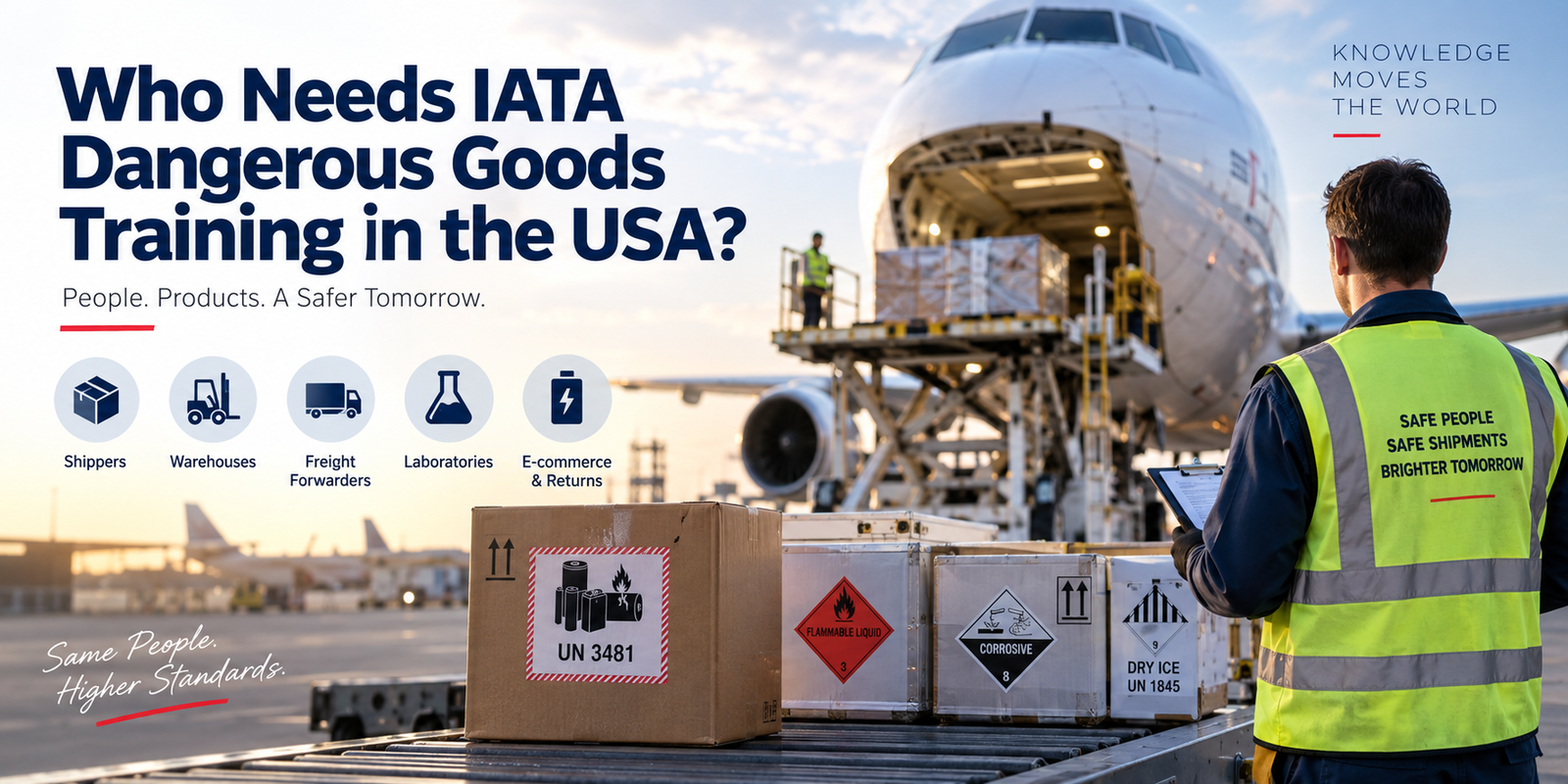
Many U.S. companies associate IATA Dangerous Goods Training primarily with airlines and specialized air cargo operators. In practice, the need for dangerous goods knowledge begins much earlier in the supply chain. Manufacturers, warehouses, freight forwarders, laboratories, e-commerce companies, distributors and even returns departments can all have employees whose work affects the transportation of dangerous goods by air.
A shipment does not become a dangerous goods shipment when it reaches the airport. Decisions made hours or even days earlier can determine whether the shipment is compliant. Someone may have classified the product, selected the packaging, applied labels, prepared documentation or simply decided that an item could be shipped as ordinary cargo. If that decision is wrong, the consequences may follow the shipment all the way to the aircraft.
For American employers, there is an additional consideration. International air transportation requirements operate alongside the U.S. Hazardous Materials Regulations in Title 49 of the Code of Federal Regulations. This means that companies need to understand not only IATA Dangerous Goods Regulations but also how dangerous goods training fits within their obligations under U.S. law.
It is the function, not the job title, that matters
One of the most important principles in dangerous goods training is that job titles alone do not determine training needs.
An employee does not have to be called a “Dangerous Goods Specialist” to perform a function that affects hazardous materials transportation. A warehouse associate, shipping coordinator, logistics manager, laboratory technician or customer service employee can make decisions that directly influence whether dangerous goods are transported correctly. Under the U.S. Hazardous Materials Regulations, hazmat employee training is largely function-based. Employees who perform regulated hazardous materials functions must receive training appropriate to those functions.
The same practical principle is increasingly central to dangerous goods training in aviation. Training should reflect what employees actually do. Consider a company that manufactures electronic equipment. One employee may package products containing lithium batteries. Another prepares shipping documentation. A third books the shipment with an air carrier, while an employee in the returns department receives damaged battery-powered equipment from customers.
All four employees may interact with dangerous goods, but their responsibilities are different. Their training requirements may therefore also be different.
Shippers preparing dangerous goods for air transport
Employees who prepare dangerous goods shipments are among the most obvious groups requiring appropriate training. Their activities may include identifying dangerous goods, determining the correct classification, selecting the proper shipping name and UN number, determining permitted quantities, selecting packaging, applying marks and labels and preparing dangerous goods documentation. These are not administrative details. They are safety controls.
Air transportation places particularly strict limitations on certain dangerous goods. Some materials may be permitted aboard cargo aircraft but prohibited aboard passenger aircraft. Quantity limits can vary according to packaging and aircraft type, while certain substances or articles may be prohibited from air transportation altogether. Employees making these decisions therefore require sufficient function-specific knowledge to perform them correctly. A general IATA Dangerous Goods Awareness course can provide valuable foundational knowledge, but employers should distinguish awareness from qualification to independently perform complex dangerous goods functions.
Warehouse and fulfillment center employees
Warehouses are another important group. A warehouse employee may never complete a Shipper’s Declaration, but that does not mean dangerous goods training is irrelevant. Employees may receive packages carrying hazard labels, prepare orders containing regulated products, consolidate shipments, apply handling marks or transfer goods into an air freight stream. Recognition is particularly important. Products that appear ordinary can contain dangerous goods. Aerosols, perfumes, paints, adhesives, cleaning products, chemicals, batteries and equipment containing batteries are common examples. An employee who does not recognize that a product may be regulated can unintentionally bypass the company’s dangerous goods procedures. Awareness training can therefore be highly relevant for warehouse personnel whose responsibility is to recognize potential dangerous goods and refer them to appropriately trained specialists.
Freight forwarders and logistics providers
Freight forwarders occupy an important position between shippers and air carriers. Depending on the services they provide, their employees may receive dangerous goods documentation, inspect packages, consolidate cargo, prepare transport documentation or arrange transportation with an airline. The required training should reflect those functions. An employee who only receives initial booking information may require a different competency level from an employee responsible for accepting a fully regulated dangerous goods shipment.
For logistics companies handling multiple modes of transportation, the training analysis becomes even more important. The same employee may encounter road, ocean and air transportation requirements during a single working day. A shipment moving from a U.S. manufacturer to an overseas customer may begin under U.S. highway requirements before continuing under international aviation requirements. Employees need to understand which rules apply to the functions for which they are responsible.
Lithium batteries have dramatically expanded the audience
Lithium batteries are one of the clearest reasons why dangerous goods awareness is no longer relevant only to traditional chemical companies. Modern commerce depends on battery-powered products. Laptops, mobile phones, power tools, medical devices, measurement equipment, cameras, industrial equipment and countless consumer products contain lithium batteries.
Different regulatory provisions can apply depending on whether batteries are shipped alone, packed with equipment or contained in equipment. Battery type, capacity, condition and packaging configuration can also affect the requirements. This creates potential dangerous goods responsibilities in organizations that may not think of themselves as hazmat shippers. E-commerce businesses are a good example. A fulfillment center may handle thousands of consumer products, only some of which contain regulated batteries. Employees responsible for receiving, picking, packing and returning those products need procedures that prevent regulated batteries from accidentally entering the air transportation system as ordinary cargo.
Returns operations deserve particular attention because a battery that was safe when originally sold may return damaged, swollen, defective or subject to a safety recall. Such conditions can significantly affect whether and how it may be transported. Awareness training helps employees recognize when specialist intervention is required.
Laboratories, healthcare and technical companies
Another frequently overlooked group consists of laboratories, healthcare organizations, research facilities and technical companies. These organizations may occasionally ship samples, diagnostic specimens, chemicals, dry ice, battery-powered equipment or other regulated materials. Because dangerous goods shipping may not be their primary business activity, employees can underestimate the regulatory requirements. Occasional shipments do not automatically mean that training is unnecessary.
If an employee performs a regulated hazardous materials transportation function, the frequency with which that function is performed does not remove the need for appropriate knowledge and training. This is particularly important where employees prepare shipments themselves rather than transferring the entire preparation process to a specialist dangerous goods provider.
What should IATA awareness training cover?
Awareness training should give employees a practical understanding of the dangerous goods system and enable them to recognize when additional requirements apply. Depending on the employee’s role, introductory training can address the nine hazard classes, UN numbers, proper shipping names, hazard labels, marks, packaging concepts and basic documentation principles. Employees should also understand why air transportation imposes additional restrictions and why apparently small errors can have serious consequences. Lithium batteries, hidden dangerous goods and undeclared shipments deserve particular attention because employees outside traditional dangerous goods departments frequently encounter them. The objective is not to turn every warehouse employee into a dangerous goods specialist. The objective is to make sure employees know enough to recognize the limits of their responsibilities. A well-trained employee should understand when a shipment can proceed according to established procedures and when it must be stopped and referred to someone with more specialized dangerous goods knowledge.
IATA training does not replace every 49 CFR requirement
This distinction is especially important for U.S. employers. Hazardous materials transportation in the United States is subject to the Hazardous Materials Regulations. Under 49 CFR Part 172, Subpart H, hazmat employers have responsibilities concerning the training, testing and certification of hazmat employees. Training under 49 CFR §172.704 includes general awareness and familiarization, function-specific training, safety training and security awareness training. In certain circumstances, in-depth security training is also required.
Air transportation also introduces modal requirements. An IATA Dangerous Goods course may cover substantial portions of the knowledge an employee needs, but employers should not simply assume that possession of an IATA training certificate satisfies every requirement imposed by U.S. law. Instead, the employer should compare the training received with the functions performed by the employee and the applicable U.S. requirements. Where gaps exist, additional training should be provided. For many organizations, this means combining IATA-focused training with appropriate U.S. DOT 49 CFR hazmat training.
Awareness versus function-specific training
This is perhaps the most important distinction for employers choosing a course. Awareness training is appropriate where employees need to recognize dangerous goods, understand the basic regulatory system and know how to respond when potentially regulated materials are encountered. It should not automatically be considered sufficient for every employee who prepares dangerous goods shipments.
An employee responsible for determining whether a chemical meets a particular classification criterion requires deeper knowledge. The same applies to employees selecting packing instructions, preparing regulated documentation or making decisions concerning complex lithium battery shipments. Employers should therefore map their employees according to their actual responsibilities.
For a relatively simple organization, this might mean dividing personnel into employees who need basic awareness, employees performing specific dangerous goods functions and dangerous goods specialists responsible for complex regulatory decisions. This creates a much stronger training system than assigning the same course to everyone.
A practical question for every U.S. employer
Companies can begin with a simple question: Can any of our employees cause dangerous goods to enter the air cargo system?
If the answer is yes, the company should examine those employees’ functions. Who identifies the product? Who determines whether it is hazardous? Who packs it? Who applies the labels and marks? Who prepares the shipping documents? Who books the shipment? Who handles lithium battery returns? Who decides whether an apparently ordinary product can travel by air?
Those questions often reveal training needs that were previously overlooked. For many employees, IATA Dangerous Goods Awareness Training is the appropriate starting point. For employees performing regulated shipping functions, additional function-specific training may be necessary. U.S. employers must also ensure that applicable 49 CFR training requirements are satisfied. The result should be a training program based not on job titles or certificates, but on actual responsibilities. In air cargo, the first safety decision is often made long before the aircraft leaves the ground. Making sure that the person making that decision has the right knowledge is one of the most effective ways to prevent undeclared dangerous goods, rejected shipments and potentially serious incidents.