

International Bacteria Exposure & Risk Database – English
$65,00
Description
Gain fast access to structured information on bacteria relevant to human health, animal health, food safety, water management, agriculture, laboratories and industrial activities.
The International Bacteria Exposure & Risk Database is an extensive English-language Excel database containing 564 unique bacteria and bacterial groups. It helps safety professionals, laboratories, educational organisations, food companies, veterinary businesses and industrial workplaces identify where bacteria may occur, how exposure or transmission can take place and what the possible consequences are for humans and animals.
What information is included?
Each database record contains up to 30 information fields, including:
- Scientific name and alternative or former names
- Taxonomic family
- Gram reaction and morphology
- Oxygen requirements and spore-forming ability
- Typical habitats and natural reservoirs
- Countries or regions where the bacterium commonly occurs
- Materials, products, animals or environments in which it may be found
- Transmission and occupational exposure routes
- Potential health effects for humans
- Potential health effects for animals
- Typical diseases or outcomes
- Zoonotic potential
- EU human biological-agent risk group
- Biosafety and containment considerations
- Antimicrobial resistance relevance
- WHO AMR priority status, where applicable
- Relevant workplaces and industrial sectors
- General prevention and control measures
- Evidence level and source references
- Direct links to primary information sources
Easy to search and filter
The database is supplied as a professionally formatted Excel workbook. Filters allow users to search and sort the records by bacterial name, primary application, EU risk group, zoonotic potential, evidence level, AMR relevance or occupational setting.
The workbook contains five practical worksheets:
- Read Me – scope, instructions and important limitations
- Summary – overview of database coverage and key classifications
- Bacteria Database – the complete filterable database
- Glossary – explanation of risk groups, reservoirs, zoonoses, AMR and evidence levels
- Sources – register of authoritative sources used in developing the database
Who is this database for?
This product is particularly suitable for:
- Laboratory managers and laboratory safety officers
- Occupational health and safety professionals
- Biosafety and biosecurity personnel
- Food manufacturers and food-safety specialists
- Water-treatment and wastewater organisations
- Hospitals and healthcare facilities
- Veterinary practices, farms and animal laboratories
- Pharmaceutical and biotechnology companies
- Educational and training organisations
- Universities and research institutes
- Consultants conducting biological risk assessments
- Companies developing procedures, training courses or inspection tools
Based on recognised sources
The database has been compiled using information from recognised organisations and official publications, including the European Union, the World Health Organization, the Public Health Agency of Canada, the CDC, the FDA, WOAH, EFSA, ECDC, EPPO and NCBI.
Every record includes an evidence grade. This makes it immediately clear whether the information is supported by a species-specific governmental dossier, a formal classification or a screening-level profile requiring additional verification.
A practical starting point for biological risk management
Information about bacteria is often scattered across legislation, pathogen safety data sheets, scientific databases and sector-specific guidance. This Excel database brings essential information together in one structured and accessible product.
It can support preliminary biological hazard identification, workplace risk assessments, laboratory preparations, training development, hygiene programmes, emergency planning and internal audits. The database can also be expanded with company-specific organisms, monitoring results or national requirements.
Product specifications
- Language: English
- Format: Microsoft Excel (.xlsx)
- Number of records: 564
- Information fields: 30 per record
- Number of worksheets: 5
- Editable and filterable
- Suitable for international use
- Includes source references and direct web links
- Supplied as a digital product
Important notice
This database is a practical reference and screening tool. It is not intended to represent every bacterial species known to science and does not replace a species- or strain-specific risk assessment.
Pathogenicity, host range, antimicrobial resistance, transmission routes and required containment measures may vary according to the strain, concentration, activity, route of exposure, exposed population and applicable national legislation. Users must verify current local requirements and consult qualified medical, veterinary, laboratory or biosafety professionals where necessary.
Bring structure to biological hazard identification with one extensive, searchable and professionally developed Excel database.

Related products
-

Confined Space Scenario & Risk Database – Professional Edition
$199,00 Add to basket -
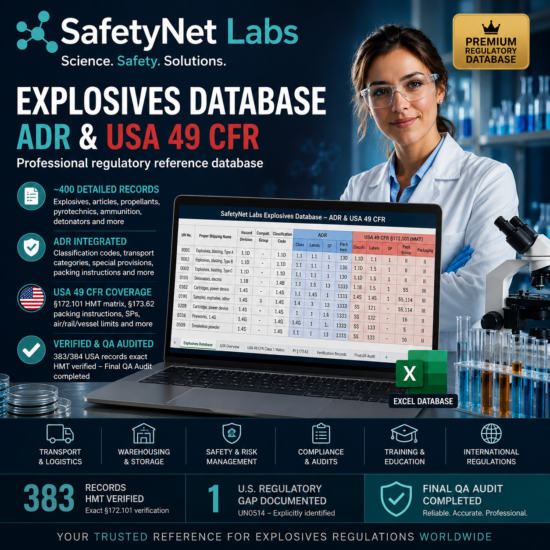
SafetyNet Labs Explosives Database – ADR & USA 49 CFR + updates 2027
$329,00 Add to basket -

Fungi Exposure & Risk Database
$169,00 Add to basket -
Sale!
Chemical Reaction and Compatibility Tool – Professional Excel Database (English)
Original price was: $129,00.$110,00Current price is: $110,00. Add to basket